“it is Real. it is Rael”

When it’s cold, it comes slow.
it is warm, just watch it grow.
-all around me.
it is here. it is now.
Just a little bit of it can bring you up or down.
Like the supper it is cooking in your hometown.
it is chicken, it is eggs,
it is in between your legs.
it is walking on the moon,
leaving your cocoon.

it is the jigsa. it is purple haze.
it never stays in one place, but it’s not a passing phase,
it is in the single’s bar, in the distance of the face,
it is in between the cages, it is always in a space
it is here. it is now.

Any rock can be made to roll,
If you’ve enough of it to pay the toll.
it has no home in words or goal,
Not even in your favourite hole.
it is the hope for the dope.
When you ride the horse without a hoof.
it is shaken, not stirred;
Cocktails on the roof.

When you eat right fru it you see everything alive,
it is inside spirit, with enough grit to survive
If you think it’s pretentious, you’ve been taken for a ride.
Look across the mirror, before you chose decide
it is here. it is now
it is Real. it is Rael
‘cos it’s only knock and knowall, but I like it.

Genesis, “The Lamb Lies Down on Broadway”, Charisma, 1974


dal blog di Fabio Z. (gennaio 2005):

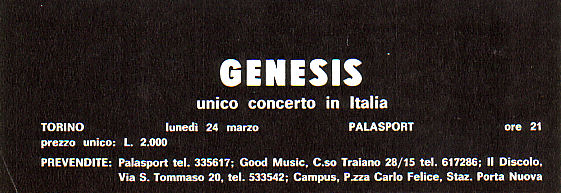
Il “Club del 24 marzo” accoglie solo soci di diritto. E’ una accolita numerosa che coltiva la reminiscenza come un antico segreto, si incontra nei locali dove si suona e, appena può, sfodera la memoria di quella notte, cerca particolari dimenticati e prova una felicità immensa nei dettagli che ritornano. Era un lunedì, quel 24 marzo, un lunedì di trent’anni fa. Al palasport del Parco Ruffini i Genesis misero in scena l’unico concerto italiano del loro tour più acclamato, quello in cui suonavano integralmente, come un’opera classica, il loro disco migliore, The Lamb Lies down on Broadway. Poco meno di due ore di sogni, maschere e diapositive, uno show globale, forse il primo vero musical rock. Dentro, diecimila (e più) persone stipate all’inverosimile, silenziose e incredule. Fuori le botte, le cariche dei celerini in grigio contro gli autoriduttori, le macchine in fiamme, la pioggia dei lacrimogeni. Che peccato. Per cinque anni non si videro più concerti da queste parti e, nel frattempo, era scoppiata la febbre del sabato sera.

Il giorno del Lamb finì così per assumere la fisionomia di uno spartiacque, il simbolo della perdita dell’innocenza per una generazione numerosa che da allora avrebbe dovuto misurarsi con la musica commerciale nei disastrosi anni Ottanta. «Ciao, veniamo da lontano perché vogliamo suonare in Italia per voi e avere una bella festa – recitava in italiano la voce di Gabriel prima che lo spettacolo avesse inizio -. Abbiamo scritto una lunga storia, questa sera desideriamo raccontarvèla tutta (…) Grazie Italia, questa è la storia di Rael».

Già, Rael, il portoricano che si muove in una New York irreale, dove sta succedendo qualcosa d’insolito, la città si distrugge e in Time Square c’è un muro della morte. Incontra Groucho Marx e Lenny Bruce, insegue il fratello John per cento minuti e, quando lo trova, scopre che non cercava altro che se stesso. Luca De Gennaro, direttore musicale di Mtv Italia, afferma ancora oggi la convinzione di aver visto due Peter Gabriel sul palco. «Alla fine, durante “It”, si assiste ad un’esplosione, s’infiammano le strobo e spuntano due figure identiche che si guardano. Non ho dubbi. Era due volte la stessa persona. Nessuno mi convincerà mai che uno era un falso». Aveva quindici anni, il dj, ma si sentiva un veterano. «Era il terzo concerto dei Genesis – racconta -. Grazie a mio fratello maggiore facevo già parte del club“. I suoi ricordi, come quelli di tutti gli altri soci del 24 marzo, traboccano di sorpresa.

«C’era lo stupore di assistere al film di quello che avevamo sentito sul disco», spiega Luciano Alberti, direttore delle Librerie Feltrinelli di Torino: «I Genesis, come gli Yes, erano già considerati dei classici, anche se non avevano la forza dirompente di altri gruppi dell’epoca, come i Rolling Stones ad esempio. Li ascoltavamo quasi di nascosto. Era bella la loro complessità, la ricchezza del concetto che si celava nella loro opera». Danilo Steffanina, esperto informatico, pinkfloydiano di razza, s’unisce al coro di «meraviglia» e subito riporta il discorso sui due Gabriel, «all’ologramma magico del gran finale», come alla cosa più toccante: «Non immaginavo che avrei visto uno spettacolo simile. Una teatralità esasperata e contagiosa».

Il mio primo flash di socio del “Club del 24 marzo”, che si coniuga con quelli di amici come Mauro e Nico, mio fratello Sandro e cento altri, è l’informe Slipperman giallo che salta per il palco mimando il volo di un corvo poco dopo essersi fatto esplodere gli attributi: era un passaggio chiave per aspirare a più alti traguardi. Rivedo Collins batterista indiavolato, le avvolgenti e mitologiche Lamia, e le dita di Gabriel che si avvicinano, si toccano e si allontanano nella romantica Carpet Crawl. La paura all’uscita, era guerriglia vera. Ma quella è passata e il ricordo rimasto è la convinzione che, da quella notte, la musica, l’arte e il concetto di spettacolo per me non sono più stati gli stessi.

Genesis – Torino 1975
Palasport Parco Ruffini
Torino
Italy
03/24/1975

01.Introduction to the show
02.The Lamb Lies Down On Broadway
03.Fly On A Windshield
04.Broadway Melody Of 1974
05.Cuckoo Cocoon
06.In The Cage
07.The Grand Parade Of Lifeless Packaging
08.Rael’s Story – part 1
09.Back In N.Y.C.
10.Hairless Heart
11.Counting Out Time
12.Carpet Crawlers
13.The Chamber Of 32 Doors
14.Rael’s Story – part 2
15.Lilywhite Lilith
16.The Waiting Room
17.Anyway
18.Here Comes The Supernatural Anaesthetist
19.The Lamia
20.Silent Sorrow In Empty Boats
21.The Colony Of Slippermen
22.Ravine
23.The Light Dies Down On Broadway
24.Riding The Scree
25.In The Rapids
26.It
27.Story of
28.The Musical Box
29.Watcher Of  The Skies

24 Marzo 1975: Palasport Parco Ruffini Torino

by Rael » 24 Mar 2007, 06:22

Esattamente 32 anni fa i Genesis suonarono in Italia per l’ultima volta in formazione a 5.
Il commento tratto dal bootleg The Real Last Time:
“…E’ indubbio che, dopo il plauso iniziale tributato al gruppo dalla provincia, la storia della presenza dei Genesis in Italia sia stata principalmente legata ad una città: Torino. Anche se, per stessa ammissione del gruppo, la città da loro preferita è sempre stata Reggio Emilia, Torino li ha visti più volte protagonisti, tanto che il Tour italiano del 1975 contemplò una sola data e proprio al Palasport del Parco Ruffini di Torino. Era il 24 marzo e la band, in piena tourneè europea, tornava per il quinto Tour italiano. Nessuno sapeva della già definitiva dipartita di Gabriel alla fine delle 102 date mondiali e quindi nessuno poteva immaginare che quella sarebbe stata l’ultima volta. In Marzo avanzato persino una città asettica come Torino assume connotazioni gioiose, e comunque poco importa: i Genesis hanno sempre saputo slegarsi dai fattori ambientali e soprattutto una performance onirica, quale The Lamb poteva offrire, avrebbe cancellato la realtà circostante per caratterizzare l’intenzione sul “paysage interieur” di Rael.
Ovviamente siamo ben lontani dalle prime esperienze del 1972: qui l’emozione viene vissuta in un luogo 10 volte più grande e le persone sono 10 volte tanto, accalcate, a volte in piedi, ora di nuovo sedute come da copione. Stiamo per entrare nel Medioevo della presenza rock in Italia. Notizie di incidenti giungono dall’esterno del palazzetto: macchine rovesciate e bruciate, ma nulla è più forte della tiepida attesa che tiene incatenati fino al compimento del magico evento. Con la solita puntualità inizia il concerto e come spesso succede è Banks ad aprire le danze con l’intreccio psicomusicale di “The Lamb”: ci si guarda in faccia stupiti pensando che sia impossibile che possano suonare tutto il nuovo disco che, uscito almeno 5 mesi prima, ci aveva già fulminati con la sua stupenda complessità, però difficilmente ricreabile dal vivo. La realtà è che a quelle prime, nervose note ne sono seguite milioni di altre, fino all’esecuzione dell’opera nella sua interezza.
Certo i mezzi tecnici sono cambiati dagli inizi, i watt decuplicati, il palco è una piazza d’armi; ma l’umiltà, parente stretta della genialità, è sempre la stessa. Lo sguardo liquido di Gabriel è solo fisicamente lontano ma è chiaramente avvertibile, è la sua voce che ce lo trasmette, quasi volesse raccoglierci attorno a lui per raccontarci un sogno, una storia senza tempo. Le due chicche finali sono “The Musical Box” e “Watcher of the Skies”, versioni molto vicine a quelle dei precedenti tour tranne che nella capigliatura di Gabriel che rende visivamente diversa la maschera del pipistrello e quella del vecchio/bambino. Queste sono le ultime immagini che ci hanno riservato. Dopo quel concerto si dovette attendere 5 anni per rivedere Gabriel da noi e più di 7 per un ritorno dei superstiti della band in Italia.”

by AGGROVIGLIATO » 24 Mar 2007, 09:45

aneddoto di quel concerto ! purtroppo raccontato da chi l’ha visto…..[:.-(]
prima dell’inizio,ci sono stati moltissimi fischi !!!!!
motivo;l’organizzazione [DAVID ZARD] ha venduto piu’ biglietti del previsto,e una buona parte del pubblico e’ finita dietro il palco !!!
non vedendo quasi nulla !!!
……. a me sarebbe piaciuto lo stesso !!!!![:.-(]

by Hogweed » 24 Mar 2007, 14:42

Che figata hanno suonato dietro casa mia!!!!!

by highinfidelity » 26 Mar 2007, 06:24
Fantastico: da quando ho raggiunto l’eta’ della ragione praticamente a Torino non e’ piu’ venuto a suonare nessuno. [:-j] Fa’ piacere sapere che quando indossavo i calzoncini corti persino i Genesis fossero di casa… [:-!]
Il tour precedente!

I am the cosmos

Every night I tell myself,
“I am the cosmos,
I am the wind”
But that don’t get you back again

Just when I was starting to feel okay
You’re on the phone
I never wanna be alone

Never wanna be alone
I hate to have to take you home
Wanted too much to say no, no,
Yeah, yeah, yeah
Yeah, yeah, yeah

Never wanna be alone
I hate to have to take you home
Want you too much to say no, no
Yeah, yeah, yeah
Yeah, yeah, yeah

My feeling’s always happening
Something I couldn’t hide
I can’t confide
Don’t know what’s going on inside

So every night I tell myself
“I am the cosmos,
I am the wind”
But that don’t get you back again

I’d really like to see you again
I really wanna see you again
I’d really like to see you again
I really wanna see you again
I’d really like to see you again
I really wanna see you again
I never wanna see you again
Really wanna see you again


David Bell – Liner notes” for Chris Bell: I am the Cosmos CD reissue 1992 by Rykodisc Records

It is very hard to know where to begin; perhaps with all of those band practices out at the “back house” (no doubt the source of the ringing in my ears that has plagued me for the last twelve years), or perhaps all of the high school car-port parties, with their endless hauling of amps and PA systems.

Maybe it was the early years of the old Ardent Studios on National Ave. in Memphis. It was the start of a kind of separation. So much technology; so many buttons and dials: the cosmic electricity.

Through all of it, I watched the talent grow and develop into much more than the myriad garage bands who were hoping to be the next Beatles or Stones. This younger brother, five years my junior, was running away with only a promise. His photography, his music, and his art captivated me in the most personal ways.

Chris started playing when he was 12 or 13 years old, heavily influenced by the Beatles. It may sound like the typical beginnings of an aspiring pop musician, but in Memphis in the 60’s the sound was soul. Stax was cranking out the hits and Atlantic and Motown were in their prime. The Beatles led Chris to the Who and the Yardbirds, and his Anglo leanings made him something of an outsider. He formed a group with two like-minded Memphians Richard Rosebrough and Terry Manning. Both men were to play a considerable role in Chris’ future recordings.

It was in high school that Chris met the pre-Box Tops Alex Chilton. Though Alex occasionally jammed with the band, Chris felt that Alex wasn’t interested in a future in music. This was confirmed when Chris tried to get Alex to join the band permanently. Chilton declined and went back to school. In the meantime Chris and his group continued to play high school dances, but it wasn’t what he wanted to do. “I hated (playing those shows) because all they wanted to hear was soul, Sam and Dave, you know?”.

Eventually, college lost its’ appeal and Alex returned to music as a member of Ronnie and the DeVilles, who metamorphosized into the Box Tops. Set apart by Alex’s raw vocals, the Box Tops had ten hits, but the group was an outlet for producers Dan Penn and Spooner Oldham. Alex became frustrated with the format of the group, in which he was unable to express himself. Eventually he quit In late 1969.

ln the meantime, Chris had been spending more and more time at Ardent in Memphis. His group continued to play, but the influence of Sgt. Pepper was enormous and he wanted to learn more about studio technique. He became a part-time engineer there, learning as he went along. During this period he recorded the first of his own compositions. Shortly aftenward, he leh for college at the University of Tennessee at Knoxville, where he roomed with Knoxville resident and former high school friend Andy Hummel.

After a year of school, Chris and Andy returned to Memphis, eventually forming a group with Jody Stephens. Alex had gone to New York after walking offstage during his final Box Tops gig. Failed attempts to lure Chris to New York with an eye towards starting a Simon and Garfunkle-style duo eventually led Alex to return to Memphis.

Ardent was now more than a studio; it was also a label set up around an unreleased Chilton record. John Fry and Terry Manning were looking for acts. One night Alex came to the studio to play with Chris, Jody and Andy. Impressed by Chris’ material, Alex played him some of his own songs, which in turn impressed Chris, who’d only heard Alex playing other peoples songs in the Box Tops. This mutual admiration manifested itself as Big Star.

Oddly, it was never a source of envy or jealousy to have a younger brother possessed of such talent; instead, it was so much fun. While Big Star was recording their first album he went off to university (Southwestern at Memphis), and I went off to other countries. He always kept me abreast of his music with tapes and letters. For one of his class projects Chris turned in Big Star’s #1 Record.

As I recall, he got an excellent grade. Chris and Alex wrote like Chris’ idols, The Beatles. While ten out of the twelve tracks are credited to Bell/Chilton, they had primarily written apart. “I would suggest a few things, changes etc., to Alex’s numbers and he would similarly add to mine but really it was a separate thing”. So separate in fact, that a few of the songs had actually been recorded by Chris prior to Big Star’s existence. Alex added parts and they became Big Star originals. By 1971 I had settled in Italy and it was while I was living there that Big Star’s #1 Record was released. I did not hear the album until I returned home in the summer of 1972. Everything seemed to be falling apart with the band, and my brother had apparently tried to do himself in. Sitting on his bed, I listened to his album for the first time and cried. I knew his talent was extensive, but I hadn’t imagined that he was capable of this. He was in terrible pain, feeling that he had put forth his best effort producing one-half and engineering three-fourths of the album, only to see his efforts lost in a distribution deal with a record company whose claim to fame had been a score of black Memphis soul products and who obviously didn’t know or care how to distribute a white, Anglo-influenced rock group. Whatever the reason, and personalities were a factor, my brother was near rock bottom.

The immediate objective was to get him out of this environment. A ticket to Italy was purchased, and I made plans to distract him for as long as I could to help him through his depression.

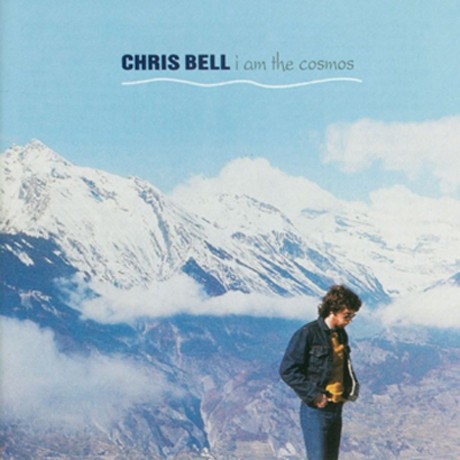
Suffice it to say, the trip to Italy was a bust, notwithstanding side trips to Switzerland, England, and other points. He drank an alarming amount of bourbon and was generally inconsolable. One of the few high points of the trip is the picture we took in the Alps that now graces this album. When he returned to the U.S. in the fall of 1972, he left Big Star. I was still worried about him.

Over the next two years Chris managed a few visits to LA. He spent time with Andrew Lauder and was encouraged by the likes of Bud Scopa and Greg Shaw. Unfortunately, none of this brought him out of his depression. He had attempted suicide at least twice during these years and had been hospitalized as a result. A brief reunion with Alex and Jody led to three songs on Big Star’s Radio City (“O My Soul,” “Way Out West,” and “Back Of A Car”), but the extent of Chris’ involvement is sketchy at best.

During the course of four or five trips to the States to visit family, I saw a slow deterioration in Chris. He had occasionally sent me demos which showed that he continued to grow musically and lyrically, but on the personal side, his sadness was a constant source of concern to me. It culminated in a horrific scene during a trip home in the summer of 1974. After a night on the town, I returned home and walked into my brother’s room to find him pulling with his teeth on a rubber tourniquet, a syringe in his hand. I froze. Not wanting to harm him in some sort of struggle with the needle, I stood and watched.

Now there was no choice but to get him out of Memphis away from the availability of drugs and onto something as happy and productive as possible. So I dangled a carrot in front of him. We should go to France to do some recording at the studios of the Chat eau D’Herouville where Elton John had recorded “Honky Chateau” and “Goodbye Yellow Brick Road.” I somehow had to make him feel like a star, like someone on the verge of discovery, especially with his recent track record of uniformly fabulous reviews for #1 Record.

Arrangements were made for Chris to fly over in September with Richard Rosebrough. Richard had been instrumental in engineering and drumming on many of Chris’ songs, and also an integral part of many of the earliest Ardent recordings.

They arrived in Italy in mid-September of 1974 and after a holiday of about ten days in Rome and the north of Italy, we ended up at a garden party in the countryside out from Torino. Several Italian industrialists, guests of the party, continually asked Chris to play some songs.

He complied, and, after finishing one number during which everyone continued to talk, he began playing Joni Mitchell’s People’s Parties. Singing in English, the Italian guests never understood the return of the insult. However, a teenage son of one of the businessmen got up and left in disgust. He was elated two months later when I presented him with a copy of #1 Record.

The next morning we took a train to the studio. Arriving the following day at the station in Pontoise, some forty kilometers from Paris, we were met by people from the Chateau who drove us to the village of Heureville. The Chateau had been the setting for many a tryst between Chopin and Georges Sand.

The reception was a nice stroke for Chris’ ego, in that his reputation had preceded him. Several quality songs were put down on tape here, though his initial disappointment upon finding the exact same recording console he’d left behind in Memphis might have been disastrous. As recording progressed, we learned that our English engineer, Claude Harper, had been a technical engineer at Apple in London, working with Geoff Emerick. Geoff had engineered all of the Beatles’ recordings from Sgt. Pepper onwards. Claude made a call to London and has able to arrange a few days for us in October at George Martin’s Air Studios. Mixing tracks with Geoff at Air was a remarkable experience. Chris showed no deference to Geoff in spite of his impressive history, yet certainly respected his talent. He once wrote me that all the time he spent in England had been worth it, if only for that one mix Geoff had done of “I Am The Cosmos.” On our last day at Air an acetate arrived from EMI and we were treated to a preview of Junior’s Farm which interestingly enough had been recorded in Tennessee. With a not-so-subtle grin, Chris asked Geoff if he needed a tape delivered to EMI studios that night. Not so coincidentally, Geoff was going to be doing a final mix of Junior’s Farm there with McCartney. At first, Geoff seemed a bit ill-at-ease with the proposal, but said that we might stop by for just a few minutes. We were met by Geoff in the control room of Studio 2, where all of the Beatles’ songs had been recorded until the time of Apple. In about ten minutes, a ruckus in the hallway announced Paul’s arrival. He and Linda strode in and after about ten minutes of chit-chat Chris and I left to see Studio 1, which seemed so big that a football game could be played in it. We returned to Studio 2 and had a few more minutes generally centered around recording technique, with Chris asking how all the different vocals were achieved. Then it was over and we said goodbye. Stepping out into the hall I seemed to make out a radiance on Chris’ face. He felt he had arrived!

“One down, two to go, he said, in reference to Harrison and Lennon. Apparently he had no interest in meeting Ringo.

The mixing ended and it was time for us to go our separate ways. He returned to the States and I to Italy. We met again in Memphis for Christmas and decided to meet again in the French West Indies. Italy had run its course with me and Chris still needed guidance. At this point it was more a case of the blind leading the blind, I’m afraid.

On the first of February 1975, I arrived on the island of St. Maarten. Part of my reward for being in the marketplace in Italy wound up being an interest in a home on this lovely and at that time, remote island. Leaving the seeming stability and structure of a business without a clue as to what my next move would be, I was hardly prepared to guide my brother.

But after two and a half months of false starts I knew that any business venture in the Caribbean was out of the question. The logical next step was to return to England and attempt to sell our best asset, the music of Chris Bell.

We arrived in London in the middle of April 1975, and soon made arrangements for mixing time with Geoff at Air in Oxford Circus. A few more songs were polished and aher a month there were enough tunes in the can to begin shopping tapes. All the while Chris played and wrote on his Gibson Sunburst acoustic. When he wasn’t playing he was cooking or doing other jobs around our basement flat on Kildare Terrace. We re-contacted several acquaintances from our earlier trip and were fortunate enough to find a true friend in John Tobler who at the time, was a press officer for CBS records.

Through John we obtained lists of A&R men at virtually every record company in England. It is amazing how many times one can get rejections and still plod on to the next office looking for one person who understands what you do. Through John there were interviews arranged for British fanzines and a long lunchtime interview with Max Bell of New Musical Express. There were introductions to various press people who had been Big Star fans; they helped fan the flames of interest. All of this activity gave impetus to the goal of finding a record deal, which over the course of eight months yielded only two bites: Dave Crokerat Rocket and Jerry Gilbert at Charisma. In the end neither offered a deal, and that was it.

Chris returned to Memphis for a six week period from late July to early September, during which he managed some studio time. He talked to Jody Stephens and Ken Woodley about coming to London to tour with one other musician as Big Star. He also contacted Alex Chilton to discuss fixing Alex’s latest album and even the possibility of them working together again.

The latter idea was quickly abandoned, as the two not only had musical differences, but had gone vastly different routes in their personal lives.

Both Jody and Ken figure prominently on album cuts, especially Ken on bass and organ on “Cosmos,” “i Got Kinda Lost,” and “Though I Know She Lies.” It should be noted that Cosmos,” “I Got Kinda Lost” and “I Don’t Know (Get Away),” were all recorded in one night at Shoe Recordings in Memphis during 1973 or 1974. I was not present at this session but would have given my eyeteeth to be there.

[Cosmos Pic #3]Chris returned to London on September the 5th; soon thereafter he began playing folk clubs to keep busy and earn an extra pound or two. Money was flowing out and precious little was coming in, but one lucrative night at a West End casino fortune smiled and afforded us a trip to Berlin. We had heard from the musician’s grapevine that gigs were to be had for foreigners with guitars. We set out in the Volkswagon beetle for the first night’s stop in Amsterdam. My brother, as was his wont, delayed our departure long enough to make us miss the ferry at Dover. As a result we arrived very late in Amsterdam. The desk clerk at the Hotel warned us not to leave anything in the car, as the neighborhood was rather seedy. Exhausted, we both decided to trust the universe and were subsequently robbed of everything in the trunk of the car. The booty was not inconsequential. I was sick for several days; Chris was impatient, so I gave him some money for a train to Berlin. He was to leave me a message at American Express.

Several days later, arriving in Berlin, I decided to treat myself to a good hotel. After checking in, I went to pick up my message at American Express. Of course, there was no message.

We both had lists of folk-rock clubs that were offering work, so I began to scour them for Chris. Two nights later, in the green room of one of the clubs, I found him about to go onstage. He seemed completely oblivious to the fact that he might have been lost forever in Germany. God protects. This period began to be known as the Pension Funk: I swear that was the name of the place where we stayed.

[Cosmos Pic #4]The trip to Berlin lasted about ten days, during which we did a photo shoot. It yielded a few commercial, yet interesting, frames. The pub gigs were quite easy to come by, but unfortunately did not command a very large purse. On one of our last nights there we stopped by the largest and best known of the clubs and asked for a spot during the break of the featured artist (some German with a record out, whose picture was plastered all over the entrance to the club). The management was quite accomodating and Chris was given fifteen minutes during the break.

He was introduced and came to center stage with three white spotlights shining on him. The superb German audio equipment, together with a talented engineer, produced a short set that should have been recorded for posterity. When Chris was treated like a professional, he rose to the occasion brilliantly. It confirmed my belief that given the proper circumstances, his talent would truly soar.

These adventures were great fun, but unfortunately they didn’t generate any substantial income. With funds running low we decided to head back to London.

Along the way we detoured and went to the Chateau, to visit the friends we had made there. The hospitality was warm, and as it was my birthday they broke out bottles of champagne. The French still know how to do things well.

On arriving in London we were faced with the problem of finding a new flat, as our lease had expired and our landlady had ignored our assurances that we wanted the flat for another three months. Now came a series of bed and breakfasts which were decidedly more bed than breakfast. More folk pub dates followed, which barely covered a day’s expenses. The list of A&R men grew progressively shorter, as we seemed to approach the end of the tunnel without the proverbial light.

Earlier plans for a reformed Big Star mini-tour came to nothing as Ken and Jody could not be coaxed to England and prospects appeared to be getting slimmer. We both decided around the end of November that chances for a record deal would have to lie in the US for the time being. In December we gave up the English ghost, with the prospect of a frivolous bi-centennial year looming and we returned to Memphis.

For the next two and a half years there was a lull in Chris’ music. He had opted for the responsibility of a normal job, managing a series of fast food restauraunts in the family chain. I know that for him this was more of an exercise than anything else, but I believe the experience gave him other perspectives. In the background there was always music. He made occassional forays into the studio to test his ability. It was during this time that ‘Though I Know She Lies” was recorded. He had written the song in London and played it to me on acoustic there. It wasn’t until several years later that I finally heard the song on tape.

During this period I lived in Memphis. After a few months I moved to Denver, where I lived for the next year and a half. We wrote to each other, saw each other on holidays, and generally comiserated on the state of musical affairs and his desire to get back into the business. In the summer and fall of 1978, through a series of perfectly timed events, I found myself moving in a fairly radical direction and decided to return to Memphis. There I would spend some time with my family before moving on to a vastly diferent life.

I arrived on Thanksgiving and happily was able to spend a month with my brother. It was easy to see his joy at the EMI release of the first two Big Star records as a double album. This, coupled with interest from small labels and his return to playing live had lifted his spirits. Also a six month gig with Keith Sykes’ band had put him back into a frame of mind of a possible future in music.

A single had been released on Car Records (I Am The Cosmos b/w You And Your Sister, CRR6). It was well received at the time and is a collectors item today. Both tracks appear here.

The British press had bandied about the rumor of a UK Big Star tour with all four original members, including Chris. Chilton seemed eager to make the most of this second chance at recognition, and while the two had discussed it, the project just died on the vine.

On the early morning of December 27,1978, returning home from a rehearsal with a new band, his white Triumph TR-6 struck a telephone pole on Poplar Ave., just half a mile from our father’s restaurant. He died instantly.

[Cosmos Pic #5]Six years later, having been contacted by Ardent Studios about the interest in Chris’s unreleased material, I went into the studio with engineer John Hampton and compiled the present album, with a couple of exceptions. The additional tracks, (including “I Don’t Know”, “Though I Know She Lies” and the alternate versions of “You And Your Sister” and “I Am The Cosmos”) were added later. Thanks to Jody Stephens and Rick Clark for digging them up. The years with Chris were the best of my life. He was Vincent to my Theo, and he had a sense of humor that made me wet myself. The sadness has been replaced with a humble gratitude and a desire to continue learning, even though the teachers may not be quite so brilliant.

David Bell

To say that this album has been in the works for a long time would be a gross understatement. In the end, after all of the false stops and starts, this is a brilliant record, and yet only a small slice of Chris’ huge talent. I hope that in some small way this record will illustrate that Chris’ contribution of sterling pop music, both in Big Star and as a solo artist is a significant and vastly underappreciated one.

Chris Bell: Vocals, Guitar
Richard Rosebrough: Drums
Ken Woodley: Bass, Organ
Alex Chilton: Background Vocal on ‘You And Your Sister’
Bill Cunningham: Arrangement on “You And Your Sister”
Jim Dickinson: Piano on “Fight At The Table”

Produced by Chris Bell Recorded at Chateau D’Heurville, France, except “You And Your Sister” recorded at Ardent Studios, Memphis, and “I Am The Cosmos”, “I Got Kinda Lost’ and “I Don’t Know” recorded at Shoe Studios, Memphis. Digital Mastering by Dr. Toby Mountain, at Northeastern Digital Recording, Inc., Southborough,MA NoNoise Processing on selected tracks by Scott Leviton at Fantasy Studios, Berkeley, CA.
Package Design by Steven Jurgensmeyer
Photography by David Bell

Special thanks to: David Bell, Jody Stephens, John Fry

Thanks also to: Everyone at Ardent, Barry Ballard and Omaha Rainbow, Max Bell, Paul Dickman, Dan Efram, Dave Gibbs, Ivana Glauber, Peter Holsapple, Alan McGee, Bert Muirhead and Fat Angel Magazine, Jim Neill, The Posies, Chip Reynolds, Jeff Rougvie, Primal Scream, Robert Shipp, Chris Stamey, Teenage Fanclub, This Mortal Coil, Seth Tiven, John Tobler, Tim Tooher.
Curtas Vila do Conde – International Film Festival

“Curtas Vila do Conde – International Film Festival is now a major cinematographic and cultural event in the country. Since 1993 the Festival has consolidated its position as curator of the latest trends in contemporary cinema also gaining a prominent place in the European landscape of international film festivals. Its main attraction is the short film, but Curtas has progressed to a multidisciplinary festival around the moving images.”

[…]

During these years, Curtas Vila do Conde has done retrospectives and invited some of the most relevant filmmakers, creators and authors from the contemporary world. The following list is a way to highlight these authors and to give a context for their presence at the festival.

1993
Manoel de Oliveira
Jean Rouch
Jacques Tati
Hal Hartley
Jane Campion

1994
Artavazd Pelechian
Wim Wenders
Martin Scorsese
Aki Kaurismäki
Krzysztof Kieslowski

1995
Mikhäil Kobakhidzé
Gus van Sant
Jon Jost
Abbas Kiarostami

1996
Peter Greenaway
Matthias Müller
Chris Marker

1997
Kenneth Anger

1998
Saul & Elaine Bass

1999
Alexander Sokurov

2000
Sergei Dvortsevoy
Orson Welles
Yervant Gianikian & Angela Ricci Lucchi
Simone Fürbringer, Nicolas Humbert, Werner Penzel
Quay brothers

2001
Daniele Ciprì e Franco Maresco
Charles Bowers

2002
Roy Andersson
Dominique Gonzalez-Foester
Gustav Deutsch

2003
Eija-Liisa Ahtila
Mike Hoolboom
Charles & Ray Eames

2004
Luc Moullet
Roman Coppola

2005
Tsai Ming-liang
Manon de Boer

2006
Peter Tscherkassky
Jonas Odell
Gerard Holthuis
Hou Hsiao Hsien
Apichatpong Weerasethakul

2007
Peter Whitehead
Peter Hutton
Anna Sanders Films
David Lynch

2008
Yu lik-Wai
Lisandro Alonso

2009
Khalil Joreig e Joana Hadjithomas
Salla Tykkä

2010
Ken Jacobs
Arnaud e Jean Marie Larrieu

2011
Bruce Conner
Jem Cohen
Pierre Clémenti
Corneliu Porumboiu

What is it, the creative documentary

[…]

What is it, the creative documentary. Well, for me the term itself is nonsense because if it is not creative it is not a documentary. That is my pov, very conservative nowadays where so much is called documentary that is reportage or magazine tv. Anyway, the creative documentary is the visually born treatment of the actuality and reality we live in, filtered through a personal commitment and a personal interpretation. The creative documentary takes us to places we cannot go ourselves, or did not know existed. The creative documentary makes us happy or angry or more clever in our conception of the world. It has many layers, it provokes, it goes to core of existential questions. It is philosophy and information and experience. It goes to the heart and to the brain. In that order.

What do you think?

Tue Steen Müller

Architettura e cinema al Castello del Valentino, 2012

Capita sempre più raramente di incontrare altre persone che si occupano di cinema per discutere, approfondire, andare oltre il da fare quotidiano – figuriamoci incontrare  persone che si muovono in altri ambiti, arti, discipline. Per cui innanzitutto grazie a chi ha organizzato e ad XXXX per l’occasione di incrociare idee e punti di vista.

A partire dal fatto che tra cinema e architettura sono tante, si sa, le analogie possibili. L’essere entrambi processi di riorganizzazione e creazione di spazi e luoghi, decisivi nello strutturare il vedere e il vivere il proprio tempo.
Processi che partono dalla scrittura, dalla carta. Che richiedono e definiscono un’entità responsabile, il regista o l’architetto, chiamata a orchestrare e tenere insieme una collettività di diverse competenze e professionalità. Entità chiamata a confrontarsi con il tempo, le risorse finanziarie. Con un committente, in termini di dialettica anche aspra. E con la realtà, che non necessariamente si adegua agli schemi interpretativi, ai progetti di partenza, alle aspettative.

C’è poi, mi sembra, un legame ancora più intenso e altre analogie tra un certo documentario o ‘cinema del reale’, di cui in specifico mi occupo da tempo, e l’architettura che lavora con/nel mondo della cooperazione internazionale: analogie immediatamente percepibili sul piano concreto. I budget, l’equipe di lavoro e la strumentazione ridotti all’essenziale, rispetto al cinema o all’intervento architettonico “convenzionale”. Ma prima ancora, l’idea del confronto / incontro / intervento in positivo con la realtà nei suoi aspetti più aspri, drammatici, complessi, evitati dai più.

Una realtà che significa anche una cultura e una visione del mondo e dello spazio diversa da quella in cui ci si è formati, umanamente e professionalmente. E quindi, proprio nell’approcciarsi in maniera aperta, collaborativa e non impositiva, una situazione che porta alla necessità costante di essere aperti, di adattare, modificare, risolvere – anche improvvisando creativamente. Rispettando lo spirito del progetto di partenza, ma cambiando magari forme, materiali, soluzioni. Rispettando, insomma. Ma questo funziona, anzi, è un valore aggiunto, nella misura in cui una certa architettura, come certo cinema, si pone come vocazione oltre che (prima ancora che) professione.

Altre analogie potrebbero essere rintracciate: ad esempio il trovare nello stesso luogo, sullo stesso ‘tema’ altri architetti e cooperanti, come altri filmakers, e quindi ecco un altro tema interessante, credo, il fare rete o meno tra iniziative e progetti…

Ma XXX sa raccontarsi benissimo, ho pensato durante l’intervento, e dopo. A partire dalla scelta stessa della scuola (lo sottolineo volutamente) come tema, come progetto, come realtà concretissima. Intuita meravigliosamente – grazie! grazie! – come centro di ogni comunità. Come esigenza primaria. Come diritto. E non una scuola qualsiasi, ma una struttura bella, accogliente, con materiali e soluzioni adeguate, sostenibili, creative. Pensate e poi messe alla prova dei fatti e costruite coinvolgendo tutta la comunità. Non dovrebbe essere così in ogni dove? ho pensato. A questo punto, altra riflessione, ci vorrebbero dei filmakers che raccontino meglio questa / queste storie, si potrebbe… c’è da lavorarci, sì. Grazie.

P. M., 2012

Daniele Gaglianone

«Come spiegare che aver girato un film in montagna è per me come averlo girato in città? Ricordo la porta del balcone che si apre sul tramonto. Settembre del 1972, avevo quasi sei anni la prima volta che vidi le montagne. La mia famiglia era in fuga dal terremoto che aveva colpito Ancona e così ci eravamo trasferiti a Torino. Ero appena entrato nella mia nuova casa al quinto piano e la memoria mi restituisce una luce violacea e delle appuntite ombre blu in controluce che segnano il confine del mondo stendendosi in verticale a ridosso dei palazzi della periferia. Forse è la traccia lasciata da questa immagine che mi ha sempre fatto sentire una contiguità immediata fra due realtà distanti che talvolta si abbrac­ciano di nascosto, quasi una coincidenza totale fra Torino e la montagna, come se la geografia fisica e quella della percezione fossero una cosa sola. Quando Torino è battuta dal vento alpino le giornate divengono inaspettatamente limpide tanto che le montagne sembrano far parte della città, ma spesso esse spariscono senza lasciar traccia, quando il cielo grigio si appoggia sull’asfal­to delle strade e allora non resta che abbassare la testa come se una grossa mano costringesse a guardarsi camminare. L’incontro/scontro è continuo: la città tende verso la montagna e nel contempo la nega, gli alberi dei boschi e le ciminiere delle fabbriche. E dalla montagna la città appare laggiù nella piana come qualcosa verso la quale tornare oppure lasciarsi alle spalle, abbandonare per sempre».
Daniele Gaglianone (in D. Bracco, S. Della Casa, P. Manera, F. Prono, a cura di, Torino città del cinema, Il Castoro, Milano 2001)

Dieci anni fa Daniele Gaglianone rispondeva così alla richiesta di una testimonianza autobiografica per un volume dedicato al rapporto tra Torino e il cinema. Facendo riferimento al suo primo lungometraggio, appena terminato, I nostri anni (2000), che rappresentava in quel momento l’importantissimo esordio come ‘opera prima’, ma al tempo stesso era una sorta di summa, di approdo dopo un percorso già insolitamente ricco di film, incontri, collaborazioni e riconoscimenti (con più di venti cortormetraggi e documentari realizzati da inizio anni ’90, apprezzati e premiati in Italia e all’estero, una intensa collaborazione con l’Archivio Nazionale Cinematografico della Resistenza, paralleli esperimenti teatrali e radiofonici), Gaglianone procedeva direttamente, con sguardo scopertamente autobiografico e poetico, a parlare esclusivamente di luoghi. Quelli della propria formazione ed esperienza personale, al tempo stesso i luoghi del suo film. Lo scriveva come fosse scontato, come non potesse essere altrimenti. E con il suo costante e curioso intreccio tra scelte istintive e lucida consapevolezza teorica, Gaglianone andava direttamente al nodo stesso di un percorso registico che nel cinema italiano degli ultimi decenni spiccava (e spicca) come singolare per coerenza e radicalità: i luoghi come fulcro stesso del proprio cinema, in modo forte e quasi ossessivo, in qualche modo insolito in un cinema nazionale nella maggior parte dei casi così disincarnato, autoreferenziale, incapace di afferrare la realtà.

Luoghi: parola che troviamo anche nel titolo di uno dei suoi documentari più importanti, Luoghi inagibili in attesa di ristrutturazione capitale (1997), dedicato a un palazzo di Torino destinato ad essere “ristrutturato” – cioè cancellato – e ai suoi abitanti. Luoghi: i luoghi della propria esperienza, che si riversano costantemente nel cinema: cinema che per Gaglianone è fatto di «vere e proprie ossessioni d’autore, i segni della memoria e i segni del corpo, il canto doloroso dell’infanzia e delle età estreme e la morte delle cose…» (Zonta); è fatto di fragilità, di traumi personali, di storie che vivono però all’interno della Storia: del Novecento – col suo trascinarsi nel secolo successivo – e dei suoi traumi collettivi.

Il trauma più estremo, la guerra (in I nostri anni, intorno alla guerra e alla Resistenza, alla memoria e alla vecchiaia, e in una serie di documentari, fino all’ultimo Rata nece biti – Non ci sarà la guerra). E il trauma più sottile che consuma nel tempo, in una marginalità suburbana, né città né campagna, segnata da un’industrializzazione e poi da una de-industrializzazione altrettanto spietate (in tutta un’altra serie di cortometraggi “sull’adolescenza”, nei tanti documentari sulle vecchie e nuove immigrazioni, sulla fabbrica in lotta contro la dismissione, o quella dei veleni e del lavoro usurante come in Non si deve morire per vivere, 2005, che confluiscono tutti idealmente nel secondo lungometraggio del 2004, Nemmeno il destino).

Ma questi traumi – e anche la risposta ad essi: l’amicizia, la solidarietà, la voglia di fuga se non di riscossa, e la risposta collettiva, positiva, addirittura gioiosa che è l’esperienza concreta, storica della Resistenza – nel cinema di Gaglianone non sono astrazioni intellettuali. E non solo per la fisicità, insolitamente intensa e disturbante, sempre presente a partire dai primi corti amatoriali. Perché questi passaggi dell’esistere personale e collettivo vivono nel rapporto con i luoghi, che ne sono concausa e testimoni al tempo stesso. E i luoghi in qualche modo sono permeati di quelle esperienze e ne trattengono la memoria, in un raccordo continuo tra passato e presente, tra percezione oggettiva e mondo soggettivo e interiore, attraverso continui sfasamenti resi in modo ardito e provocatorio dal lavoro concreto sull’immagine e sul suono – anomalo intreccio delle modalità del cinema sperimentale nel tessuto narrativo.

C’è un dualismo, che Gaglianone racconta in quelle righe, tra città e montagna. Ne parla a proposito di Torino, ma può valere per tutta l’Italia del Nord industriale – tant’è che Nemmeno il destino adotta e trasporta agevolmente a Torino  un romanzo di Gianfranco Bettin ambientato a Marghera. O meglio: Gaglianone coglie pienamente quel senso, spesso proclamato, di Torino come città-laboratorio sociale e politico in cui sono anticipati e accentuati aspetti e prospettive nazionali. Lo fa filmando tutto il disagio della città-fabbrica-diffusa che sfrutta fino a quando può, schiaccia, spinge alla rabbia e alla violenza, e poi ristruttura, dismette. In questo, però, Gaglianone lascia vedere scopertamente tutto il suo disperato amore per quei luoghi, nella misura in cui bambini, uomini e donne cercano orgogliosamente, confusamente o lucidamente di ritagliarsi uno spazio vitale, gioioso – perché il cinema di Gaglianone, spesso marginalizzato, come avviene sullo schermo ai suoi protagonisti, può essere doloroso fino quasi all’insostenibilità, e allo stesso tempo pieno di una vitalità gioiosa come pochi altri.

E questa città si contrappone a una montagna che appare concreta e al tempo stesso fortemente simbolica, come spazio di fuga, di libertà possibile, come elevazione, ma anche, ci piace pensare, come modello etico/estetico per un cinema “in verticale”, un cinema che, come coloro che vengono raccontati (ragazzini, anziani, partigiani), e come Paolo Gobetti (amico e maestro di cinema e vita), procede in salita (come sulle strade di Ancona?, mi viene da scrivere). Procede in salita, in solitaria e in gruppo, faticosamente ma con anche gioia, allegria, solidarietà, allontanandosi dal centro, dal rumore, cercando aria pura. Come afferma uno dei protagonisti de I nostri anni, da ribelle partigiano: «L’aria aveva un altro odore; ed è questo che ti frega perché una volta respirata quell’aria lì ti sembra di soffocare per tutta la vita, non te la dimentichi più…»). Procede in salita cercando il proprio essere più autentico – e la memoria personale va a un incontro pubblico a Torino in università con Michael Cimino, a cui Gaglianone, che sul cinema del regista americano ha scritto la tesi di laurea, chiede insistentemente del valore metaforico della salita alla montagna sacra in Verso il sole (The Sunchaser, 1996, vedetelo o rivedetelo, e ditemi se tutto non torna).

In questa dialettica città-montagna ci sembra si iscriva in misura straordinariamente coerente tutto il percorso di Gaglianone, quanto detto e quanto lasciato sottointeso in quella dichiarazione autobiografica: partendo da un trauma – un terremoto, una immigrazione a nord – e poi crescendo nella periferia di una “città di sradicati”, tra altri figli di immigrati al Nord per lavorare alla Fiat o nelle fabbriche dell’indotto che troveremo ritratti, – o forse meglio: evocati – nei cortometraggi e poi nel citato Nemmeno il destinoMolti di loro per me sono tanti Toni, l’amico di Ale e Ferdi. È come se all’improvviso fossero tutti spariti nel nulla. Accade spesso con gli amici di quell’età: condividi intere giornate, interi mesi, anni e poi senza sapere bene perché, le strade si dividono e non li vedi più. »). 

Dagli spazi consunti, dalle geometrie pesanti e gli spigoli vivi della periferia torinese (lo scrivo con troppa enfasi e trasporto personale, lo so) , e da studi ugualmente “periferici” rispetto al consueto ambito cinematografico-umanistico (ragioneria, e una breve parentesi informatica) Gaglianone si muove verso il centro città. Che significa, tra l’altro, parlando di luoghi, i corsi di Storia e critica del cinema a Lettere moderne (dove si laureerà, come detto con una tesi su Cimino, dove studierà e assorbirà tanto cinema, i modelli più citati certo cinema dall’est come Tarkovski e Sokurov). Ma anche verso una scena culturale e politica vitale fatta di proteste studentesche, occupazioni, centri sociali, associazioni, una scena musicale locale post-punk e new wave davvero “indipendente”, (che troverà posto anch’essa nei suoi film, con il brano dei Truzzi Broders che accende un momento de I nostri anni, e con la presenza di Lalli, voce dei legendari Franti, interprete per Nemmeno il destino). E poi il Festival Internazionale Cinema Giovani (poi Torino Film Festival), che insieme alla “rivoluzione” del video iperstimola una scena vitale di film-makers e video-makers, al tempo stesso collegandola come spettatori e protagonisti all’Italia e al mondo (festival che seguirà e promuoverà Gaglianone in tutto il suo percorso).

E poi ancora, tassello fondamentale, un altro luogo, l’Archivio Nazionale Cinematografico della Resistenza, con cui Gaglianone collabora intensamente dal 1991 al 1997, e che rappresenta per lui – come per altri coetanei amici e collaboratori, tra cui Ernaldo Data e Alessandro Amaducci – una vera e propria scuola-laboratorio di cinema e di vita, grazie a Paolo Gobetti, figlio di Piero e Ada, partigiano combattente, e poi critico cinematografico, regista, inventore di fatto del cinema indipendente e militante italiano con Scioperi a Torino (1962), realizzatore di tanti film di montaggio, di ricerca antropologica, di didattica storica, instancabile organizzatore culturale, fondatore dell’Archivio, scomparso nel ’95, a cui Gaglianone dedica nel ’98 Dopo settant’anni i ricordi non esistono più – Paolo Gobetti racconta, bellissimo e illuminante film di montaggio a partire da anni di video-interviste.

Grazie a Gobetti, Gaglianone trova un mondo di testimonianze e storie, un orizzonte etico e politico clamorosamente vitale e antitetico all’appiattimento del presente; quella montagna su cui salire, come i partigiani, come Gobetti stesso, appassionato camminatore e scalatore. Gaglianone trova anche un metodo, il “metodo-Gobetti” (l’ha inventato Daniele il termine? non lo so), metodo fatto di rigore ma anche di umiltà, curiosità, sperimentazione e anticonvenzionalità; e poi, nel concreto, trova un archivio immenso (nota bene: di immagini e registrazioni audio) che è chiamato a organizzare, restaurare, organizzare. Organizzare non solo in termini storici, didattici, di testimonianza, comunicazione, ma anche in termini espressivi. Così l’Archivio, con i suoi giacimenti di pellicole e nastri, e con i suoi banchi di montaggio, diventa un laboratorio in cui Gaglianone ha l’opportunità di mettere a fuoco, progressivamente, con manualità “operaia”, un fare-cinema personale, audace, in cui la durezza e il rigore dei temi e delle storie convivono con raffinati rimandi letterari, e un lavoro via via più sofisticato sull’immagine e sul suono. Un lavoro mai fine a se stesso, ma determinato a dare profondità all’immagine, a conferire forza e dinamismo, a portare alla ricchezza dei significati.

E il percorso passa naturalmente dai tanti film prodotti per l’ANCR, che da semplici operazioni di raccolta di memorie e documentazione storica riescono a cogliere l’aspetto umano delle esperienze, ai cortometraggi più personali. In un’esperienza che porta, nel tempo, dalle prime prove amatoriali all’approdo al cinema “professionale”, allo stabilizzarsi intorno a lui di una vera e propria famiglia di amici-collaboratori. Come Giaime Alonge e Alessandro Scippa, co-sceneggiatori; Gherardo Gossi, direttore della fotografia; Giuseppe Napoli al suono; Giuseppe Sanna, il bambino-poi-adolescente-poi-giovane uomo che ricorre in tutti i film come attore feticcio / alter ego (“il mio Antoine Doinel”, dice Gaglianone divertito, facendo riferimento a Truffaut ); e poi Ernaldo Data, Alessandro Amaducci, Massimo Miride, Enrico Saletti, e altri ancora, spesso coinvolti in parallelo in un progetti teatrali con il gruppo ‘IlBuioFuori’.

Bisognerebbe parlare a questo punto dei film. Di tutti i corti e i documentari, almeno dei più intensi e rivelatori, come La ferita (1991), Era meglio morire da piccoli (1992), Cichero (1993), L’orecchio ferito del piccolo comandante (1994); dell’esperienza come collaboratore alla sceneggiatura e alla regia di Gianni Amelio per Così ridevano (1998), altro film “torinese” per eccellenza sia per l’ambientazione, sia per il rappresentare una tappa fondamentale nella “rinascita” cinematografica della città; di I nostri anni, presentato a Torino e a Cannes alla Quinzaine des Réalisateurs, premiato in Italia e all’estero, recensito con apprezzamento quasi unanime per il coraggio, l’originalità, la sperimentazione; del “difficile secondo film” di lungometraggio, l’appassionato e “non riconciliato” Nemmeno il destino (2004), sofferto come gli adolescenti e i loro genitori che mette in scena, raccontati in una città devastata e “dismessa” che suona come un clamoroso controcanto alla Torino dell’entusiasmo glamour pre-olimpico (film, tra l’altro, praticamente invisibile in Italia, quanto capito all’estero, fino a vincere, nel silenzio dei media nostrani, come miglior film al Rotterdam International Film Festival, centro nevralgico nel nuovo cinema internazionale).

E bisognerebbe parlare anche della costante produzione dei documentari, fino all’ultimo Rata nece biti (Non ci sarà la guerra), nato dal felice incontro con la giovane BabyDoc Film, estremo già nella durata di tre ore, selezionato e premiato a Locarno, Torino, e – inaspettatamente – col David di Donatello, in cui la telecamera è sulla Bosnia dopo il trauma della guerra – ma andando in Bosnia a trovare reticoli urbani simili, circondati da montagne simili, luoghi e testimoni di un dramma che potrebbe verificarsi anche qui, di nuovo, riaprendo orrori come quelli combattuti anni fa dai partigiani; e bisognerebbe poi parlare dell’ultimo, straordinario Pietro (2010), di prossima uscita, terzo lungometraggio, il più urgente, il più incisivo… Bisognerebbe: ma si sono già superati i limiti dati a questo intervento. E poi i film di Daniele Gaglianone, a differenza di tanti altri, bisogna proprio vederli con i propri occhi: come i luoghi. Se no, non è la stessa cosa.

P. M., 2010

Gravity Hill NEWSREELS (The extended version)

Film Comment
Published by Film at Lincoln Center

https://www.filmcomment.com/article/site-specifics-gravity-hill-newsreels/

Site Specifics: Gravity Hill NEWSREELS (The extended version)
Free Assembly

By Jesse P. Finnegan in the May-June 2012 Issue

As Occupy Wall Street entrenched itself in Lower Manhattan last fall, avant-documentarian Jem Cohen began paying regular visits to Zuccotti Park to collect HD footage and quickly turn around brief, deftly winnowed portraits of the movement. Further uptown, the IFC Center in Greenwich Village ran Cohen’s “newsreels” before their movie programs, and established a Vimeo page solely for exhibiting the first five Gravity Hill NEWSREELS in their rightful 21st-century place— amidst the cacophony of images generated by and about Occupy, freely transmitted and amplified online.

Cohen’s atmospheric shorts distinguish themselves among the din of Occupy videos by an alert but restrained formal register—carefully constructed, intuitively cut, strikingly composed. (Cohen has the ability to concoct on-the-scene frames that are highly refined but not constricted, poised not posed.) The videos are observational— ethnographic even—and are less expository dispatches than airy patchworks, rhythmical distillations of Occupy as it was on the ground. One short shows Zuccotti swollen with visitors during the day; another, set at night, bustles with scattered rituals and routines. The withering October 29 nor’easter is captured, hatches battened.

Clusters of occupiers sweep Zuccotti, settle into tarps, casually caucus with one another, pile in for general assembly, and brandish heartbreaking and blood-boiling handmade signs at the perimeter. NYPD mobile command units and surveillance towers loom, passersby snap photos, traffic signals and vendor carts flicker on streets that hem the park, indifferently desolate in nighttime. The shimmering trunk of One World Trade Center (aka The Freedom Tower) inches imperceptibly skyward all the while. The NEWSREELS soundtracks are clouds of ambient chatter and chanting, wind rippling through tents and ponchos, shuffles of a gathering march and idling riot cops, and the dull roar of Manhattan going about its business in the near distance. There is usually a meditative, asynchronous interlude, such as a Herman Cain soundbite, or some Joe Hunter blues.

The October march on Times Square perhaps reveals the series’ greatest strength, nimbly skirting didacticism. The streams of protesters and the megalithic consumer monuments of 42nd Street overlap one another, in fleet, precisely edged compositions. What is made vivid is not the obvious, inciting juxtaposition, but the picture of Manhattan as host to estranged bedfellows, each deaf to the other’s stubborn claims.

The Web’s blizzard of Occupy clips is apt accompaniment for a movement so multiform and often inassimilable. But the proliferating OWS footage has tended to be swallowed up in the frantic subjectivity of crowds or to deflate scenes of upheaval against Gotham’s severe geography. Divvied among the claustrophobic streets and vertiginous architecture, lower Manhattan can make even a few thousand determined protesters look pretty shiftless. For better or worse, one of the many things OWS has refused to account for, or assign itself, was a visual language with which to convey the scale and seriousness of its actions, at the very least. The NEWSREELS seem to hover within this very gap between narrations—channeling the space of a city mingled in protest to give a sense of OWS as part of the life cycle of Manhattan’s streets.

In using HD, Cohen expressed reservations about the risk of giving his images a slick, “cinematic” veneer. But the wobbly, pixelated “rawness” of amateur video is just as much an encumbered vernacular, loaded with its own connotations and expectations. Plenty of veteran filmmakers, from Jonathan Demme to Ken Jacobs, also trained their cameras on OWS, and however memorably, came away with what amounted to singular, first-person encounters with the protest, rather than careful reckonings. Cohen’s calculated tone and technique pretend towards neither a knowing remove nor an induced intimacy. Cultivated and precise as the films are, they seem so in the service of broadly sidestepping any presumption to ascribe OWS a fixed, deliberate image. Broadly sympathetic but systematically cautious, the NEWSREELS are artful enough to cut a clear line through the fray, and mindful enough to leave its multiplicities intact.

© 2012 by Jesse P. Finnegan

Testo anonimo, dalla città di T, inizio sec.XXI d.C.

Inviato: mercoledì 18 maggio 2011 18:21

Ciao,

visto che dici non ti parlo mai, ti scrivo.
solo per te, SOLO PER TE, il mio nuovo blog
quellochepensodavveroditorino.
sottotitolo: perchè amo questa città, ho fatto e sto facendo del mio meglio per renderla
più vivibile per me e per noi, ma mi sono rotto il **** di doverne sempre
parlare solo bene
primo post:

La mostra “Fare gli italiani” fa ******

Il problema è che a Torino, dopo il Museo del Cinema progettato da Confino, sembra che il modello ideale per le mostre e i musei esposizioni “di grande successo” sia il castello delle streghe del Luna Park degli anni ’70. Percorsi nel buio, “suggestive ambientazioni (leggi, scenografie di cartapesta), e luci ed effetti speciali, per dare l’esperienza e l’emozione.

Il problema è che al Luna Park si andava di nascosto dai genitori, in fondo non per essere spaventati dalle ragnatele finte e dai pupazzi animati, ma solo per vedere il pupazzo della strega che di colpo si apriva il vestito e mostrava le tette, apparizione quella sì davvero speciale.

Nel caso dei musei-mostre-evento torinesi invece ci vanno tutti, dal Presidente Napolitano in poi, ci devi andare per dovere civico, se no passi per zotico illiberale, e devi pure gioire, da torinese, orgoglioso perché “ce l’abbiamo fatta”. Come per le Olimpiadi. In tempo. Eeh?!

La mostra “Fare gli italiani” fa incazzare. Perché, sì, ce l’abbiamo fatta, ed è di grande effetto. Ma per inciso, perché le O.G.R. sono uno spazio così figo di per sè che qualsiasi menata appesa e illuminata con un faretto bianco farebbe un figurone. Poi. Poi…

Poi, se sei uno di scarsa cultura non capisci un c***o, vaghi tra video che ronzano, didascalie minuscole e frettolose, percorsi non si capisce se tematici, cronologici, o che altro, accumuli di immagini, o vuoti siderali.
Pannelli da toccare (ma perché?), e le immagini si mescolano. In modo un po’ confuso, deludendo grandi e piccini. Anche il volontario che presidia incoraggia all’uso ma poi è un po’ imbarazzato.

Se sei di media o alta cultura, allora ti inc*** proprio. Perché è tutto un buco, un volo superficiale, un navigare basso, un fare tutto un po’ uguale, un evitare le questioni.
Coerentemente, a quel punto, la Resistenza si conquista un pannello di un metro quadro circa, con due foto e un po’ righe che in confronto la scheda di wikipedia è un archivio.
Coerentemente, a quel punto, sembra efficace lo spazio del boom economico dedicato ai grandi “marchi”. Toh.

Ecco, la mostra “Fare gli italiani” fa spavento. Perché forse non è un volevamo-ma-non-siamo-riusciti, forse è proprio tutto perfettamente riuscito.

Da un certo punto di vista è geniale, se l’obiettivo è mettere in scena 150 anni di storia d’Italia.

Eccola, l’Italia. Buia. Chiusa. Un po’ fabbrica, un po’ cattedrale, un po’ caserma, autosalone, magazzino abbandonato, prigione… mattoni scuriti, cavi, metallo, sali e scendi, torna indietro? dove sono? dove andiamo?

E fantasmi. Voci, rumori, immagini che scoloriscono, che forse vorrebbero farsi sentire e capire da noi che passiamo. Forse no. 150 anni, è andata così.

All’uscita c’è una specie di tunnel con donne e uomini giovani e meno che fluttuano nell’aria. Cosa sono, anime? chiede sorridendo nostra figlia, cinque anni e mezzo, la persona più intelligente che frequentiamo. Le anime volano come acqua in un gorgo tra scritte varie, “libertà“, “ambiente“, “multiculturalismo” – credo, non mi ricordo bene perché scorrono veloci.

Usciamo.

Bastia Mondovì (Sacrario partigiano)

Bastia Mondovì (Sacrario partigiano)
Provincia di Cuneo
Sacrario partigiano Formazioni Autonome – 1° Gruppo Divisioni Alpine – Bastia Mondovì
Loc. San Bernardo, Bastia Mondovì (CN)
Colle San Bernardo, a pochi km. da Bastia Mondovì, sulla strada fra Bricco e La Notte
ente di riferimento: Comune di Bastia / Assessorato alla Cultura
T +39 0174 60112 (municipio)
F +39 0174 60393
info@bastiamondovi.info
http://www.bastiamondovi.info
———————————–
Il centro è in località isolata, il materiale didattico e informativo è si trova presso la
Biblioteca della Resistenza e della Comunità di Bastia Mondovì
Via delle Scuole 1,
Bastia Mondovì (CN)
Orari apertura:
lunedì pomeriggio: 15,30 – 17,30;
martedì mattino: 9,30 – 11,30;
giovedì pomeriggio: 15,30 – 17,30.
Informazioni: T +39 0174 60112
Responsabile: Rinaldo Elladi (sindaco).
———————————–
” Il Sacrario Partigiano, inaugurato nel 1947, custodisce i resti di diversi caduti della guerra di Liberazione e ricorda i nominativi dei caduti del 1° Gruppo Divisioni Alpine delle Formazioni Autonome che combatterono in zona.

note storiche

Bastia Mondovì, dopo essere stato per la prima metà del Novecento snodo ferroviario e stradale di fondamentale importanza per l’economia ed il commercio fra Langhe, pianura ed entroterra ligure, diventa nel periodo 1943-1945 un crocevia obbligato per uomini e merci di tutte le forze in lotta e indispensabile avamposto delle formazioni partigiane autonome, che qui operano dall’aprile 1944 alle dipendenze del 1° Gruppo  Divisioni Alpine del maggiore Enrico Martini “Mauri”. I dodici “distaccamenti” dei paesi circostanti daranno vita nel mese di agosto alla 1° Divisione “Langhe” di Mario Bogliolo, con le brigate “Castellino”, “Mondovì”, “Langhe Ovest” e “Pedaggera”.

Per tutta l’estate e l’autunno1944 i partigiani compirono azioni verso i centri nemici e le più importanti infrastrutture della pianura, fino a mandare rinforzi alla stessa città di Alba nell’imminenza del contrattacco fascista contro la “libera repubblica”. In seguito vi furono spedizioni “punitive” dei nazifascisti e grandi rastrellamenti nell’autunno-inverno 1944; gli ultimi attacchi nemici, con l’”Operazione Marder”, sono del marzo 1945: quando la guerra volge al termine, gli uomini di “Mauri” partecipano in forze alla liberazione della pianura fino a Moncalieri.

dotazione

Oltre all’attrezzatura di base collocata nei locali della biblioteca, il Centro-Rete dispone di spazi per l’allestimento periodico di mostre temporanee nei locali della ex scuola elementare al centro del Sacrario.

Storia
La cappella Sacrario delle formazioni partigiane autonome delle Langhe, posta sul colle San Bernardo (m. 539 s.l.m.), ricostruita nel 1949 dopo i danni subiti nel periodo bellico, è stata inaugurata nell’ottobre 1951 dal Presidente del Consiglio, on. Alcide De Gasperi. Domina dall’altura tutta la Langa e la pianura monregalese. Nelle giornate terse lo spiazzo antistante offre uno splendido panorama sull’intero arco alpino piemontese, fino al Monte Rosa. È circondata da vigneti e vi si accede da un vialetto introdotto da un obelisco marmoreo. Ai lati del viale sono disposti cippi commemorativi e lapidi che ricordano le medaglie d’oro ed i caduti del 1° Gruppo delle formazioni partigiane autonome alpine del maggiore Enrico Martini “Mauri”. È meta costante di gruppi di reduci, che vi celebrano da più di mezzo secolo un solenne incontro commemorativo annuale alla fine del mese di giugno.

Il paese di Bastia Mondovì (patria del partigiano Franco Centro, “il piccolo eroe delle Langhe”, medaglia d’oro al Valor Militare), dopo essere stato per la prima metà del Novecento snodo ferroviario e stradale di fondamentale importanza per l’economia ed il commercio fra Langhe, pianura ed entroterra ligure, diventa nel cruciale periodo 1943-1945 un crocevia obbligato per uomini e merci di tutte le forze in lotta e indispensabile avamposto delle formazioni partigiane autonome, che qui operano dall’aprile 1944 alle dipendenze del 1° Gruppo Divisioni Alpine del maggiore Enrico Martini “Mauri”. I dodici “distaccamenti” dei paesi circostanti danno vita nel mese di agosto alla 1^ Divisione “Langhe” di Mario Bogliolo, con le brigate “Castellino”, “Mondovì”, “Langhe Ovest” e “Pedaggera”. Coraggiose azioni delle squadre partigiane partono per tutta l’estate e l’autunno 1944 verso i centri nemici e le più importanti infrastrutture della pianura cuneese, fino a mandare rinforzi alla stessa città di Alba nell’imminenza del contrattacco fascista contro questa “libera repubblica”, cantata da Beppe Fenoglio. Non mancano sul territorio spedizioni “punitive” dei nazifascisti, risalenti a tenaglia da Clavesana e Ceva verso i centri dei ribelli e grandi rastrellamenti nell’autunno-inverno 1944. Gli ultimi attacchi nemici, con l’”Operazione Marder”, sono del marzo 1945, quando i tedeschi, puntando dritto al cuore delle Langhe, a Bastia occupano l’altura di San Bernardo (attuale Sacrario Partigiano). Quando la guerra volge al termine, gli uomini di “Mauri” partecipano in forze alla liberazione della pianura da Mondovì fino a Moncalieri.

Circondato da tre lati da portici, che ne ingentiliscono la struttura, questo Sacrario luogo della memoria offre riparo dalle avversità atmosferiche in ogni stagione ed al suo interno può ospitare nella cappella un centinaio di persone per i momenti celebrativi. Nei locali del centro rete ad essa uniti, allocati su due piani e con i doppi servizi, può invece essere ospitata una cinquantina di visitatori in occasione di mostre ed incontri.

Patrimonio
Data la posizione decentrata e poco controllabile, il centro è collegato a livello informativo con il comune di Bastia Mondovì, presso la cui biblioteca è stato creato un fondo librario specifico e consultabile sui temi resistenziali delle formazioni autonome, alimentato da mirate donazioni dei partigiani protagonisti della lotta di liberazione nelle formazioni autonome di Enrico Martini Mauri. Non sono attualmente disponibili alla consultazione documenti di archivio pubblici o privati sulla Resistenza nelle Langhe.

Attività
Gli annessi locali dell’ex scuola elementare sono stati trasformati nel 2005 in centro rete del progetto La Memoria delle Alpi, per contenervi mostre temporanee e materiale didattico per i visitatori. Ha sinora ospitato mostre fornite dall’Istituto storico della Resistenza di Cuneo e quelle promosse dal progetto la Memoria delle Alpi, nonché momenti musicali e recite organizzate dalla locale associazione “Onor Caduti.”

Offerte formative per le scuole
L’attività didattica principale sin qui realizzata con cadenza annuale è curata dall’Associazione Onor Caduti ed è rivolta a tutte le scuole del territorio di ogni ordine e grado, con un concorso che prevede, a seconda del livello, la produzione di disegni e testi aventi per tema la Resistenza. Nel mese di maggio avviene presso il Sacrario la premiazione degli elaborati e l’incontro tradizionale fra studenti e reduci partigiani.

Informazioni pratiche per le scuole
È meta del sentiero ad anello CN 19 P1, che parte da Bastia Mondovì, denominato “Storia e memoria delle formazioni autonome”. Al centro di Bastia Mondovì fanno inoltre riferimento i sentieri della libertà dell’area Monregalese, quali l’itinerario CN16P1 “La battaglia di Pasqua” a cavallo della Valle Pesio e Tanaro; il CN17P1 denominato “La ritirata della ‘Felice Cascione’”, sulla displuviale fra la Valle Tanaro e la Valle Corsaglia; il CN9P1 “Il pane quotidiano” interno alla frazione montana di Prea di Roccaforte Mondovì in Valle Ellero; il CN9P2 “La tela del ragno” ed il CN9P3 “Le missioni alleate” entrambi in Valle Ellero; il CN8P1 “tra monarchici e repubblicani”, il CN8P3 “La Prima Valcasotto” ed il CN8P2 “La battaglia di Valcasotto”, tutti e tre in Valle Casotto.

Informazioni pratiche per i visitatori
[…] Area pic-nic attorno ed all’ingresso del Sacrario (non attrezzata).

Da visitare
Località di ampio interesse culturale e turistico sono a Bastia Mondovì la Cappella di San Fiorenzo, con pregevoli affreschi quattrocenteschi alle pareti. A Chiusa Pesio il Museo della Resistenza “I sentieri della memoria”, sito in via Mazzini 4, tel. 0171 735554, info@sentieridiresistenza.it (può accogliere gruppi di 15 persone per turno al giovedì dalle 15 alle 18; negli altri giorni a richiesta. L’ingresso è gratuito ed è fornito di aula didattica, biblioteca ed archivio. Per prenotazioni rivolgersi al museo nel giorno di apertura o in municipio nelle mattinate dal lunedì al sabato (tel. 0171 734009 – fax 0171 735339).
Altri luoghi meritevoli di ampia visita sono la città di Mondovì, specie nella sua parte alta nel quartiere Piazza, di origine medioevale, ed il Santuario della Madonna di Vicoforte, dall’imponente cupola ellittica.

Fonti:qui e qui

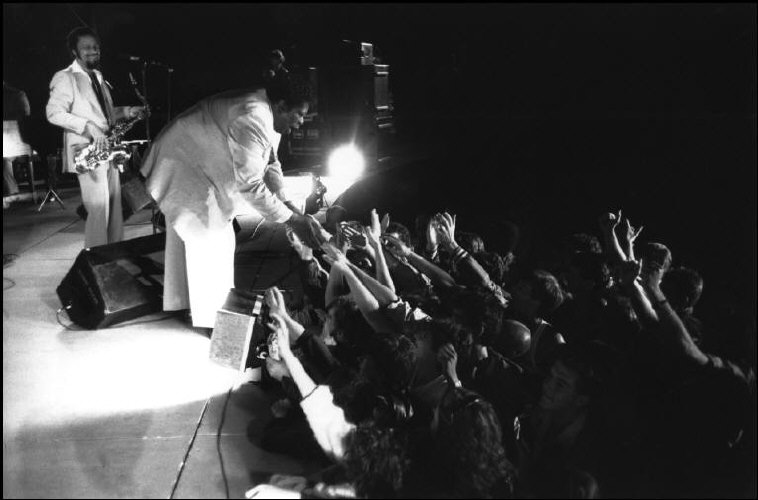
22 luglio 1984 – Torino, Punti Verdi del Parco Pellerina – B.B. King and His Blues Band

1985 – Los Angeles Time | LEONARD FEATHER

How do you like your blues served up? Greasy or gritty? Fast and funky, or blue and sentimental? Instrumental or vocal? Male or female?

Whatever one’s predilection, the B. B. King show has the recipe. At the Tuesday opening of his Concerts by the Sea engagement (closing tonight) he drew a standing ovation simply for walking on stage, and kept the capacity crowd in his thrall for better than an hour.

The career of the blues king has long moved in a steady direction. Occasionally a record producer has tried to change his image by steering him away from the idiom that has served him so well, but when he works a club for a crowd of obviously loyal aficionados, he heads for home base, singing and playing some of the same lyrics and licks that may well have delighted the parents of these same fans.

Although the impression was created of an entire blues set, King mixes it up now and then by singing a 32-bar blues-ballad or by tossing in an occasional instrumental in which Lucille, his six-stringed alter ego, is the dominant voice.

Some of the songs (“It’s Just a Matter of Time,” “When I’m Wrong I’m Wrong”) seemed new to this perennial King-watcher; but the old reliables, from “Every Day” to “Tain’t Nobody’s Business,” were still on hand, the gutsy voice and florid guitar lines as infectious as always.

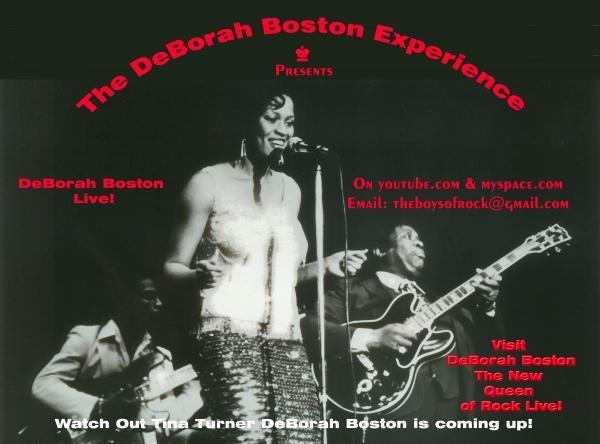
Surprisingly, King closed his set with two pieces belted out by the tall, slender, attractive Debra Boston, whose roots-conscious blues shouting is well accented by her sinuous gyrations. But when the audience refused to let the show end, King encored with “The Thrill Is Gone,” vintage 1966.

King’s six-piece band, led by the saxophonist Eddie Synigal, warmed up with two uptown Saturday night soul numbers, but seemed more at ease backing the star, with one or two after-hours solos by Eugene Carrier on piano and organ, and Leon Warren on guitar. Here again there was a contrast between the rough-and-ready sound of the group and the more polished ensembles heard on one or two of those albums. In the studio the producer may give orders, but at Concerts by the Sea, when the lights go down low, only B.B. is king.

qui